

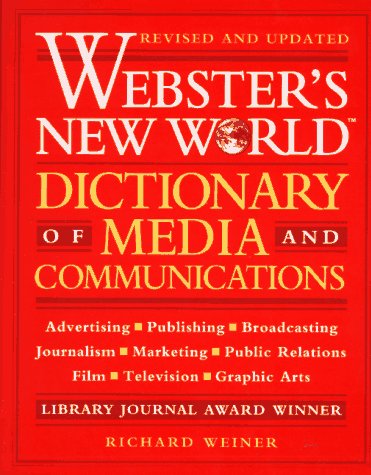
Today’s Guest: Richard Weiner, author, Webster’s New World Dictionary of Media and Communications
(Originally Published September 30, 1996; Richard Weiner passed away on January 29, 2014. He was an early and enduring supporter of Mr. Media and he will be greatly missed.)
During his career as the owner of a successful New York public relations firm — he launched the Cabbage Patch Kids — Richard Weiner frequently sent out memos updating his staff on the latest nuances in mediaspeak, or explaining the difference between a dingbat and a ding letter.
He saved the memos, first compiling an informal booklet, then an entire dictionary of media terms and definitions. This year, the second edition of Webster’s New World Dictionary of Media and Communications (Macmillan), newly revised and updated, was published. It’s packed with 35,000 entries, including words and phrases from advertising, computers, film, journalism, marketing, printing, public relations, radio, telecommunications, television and theater.
Several of the dictionary’s newest entries come from the online world, including: browser, bulletin board, flame, home page and news group. And because the language expands and twists every day, the author is already collecting words for his next edition. “The Web has a tremendous amount of jargon; I’m trying to keep up with it,” Weiner says. Likely future entries: “domain,” “Web site” “host” and “spamming,” which he defines as “the sending of unsolicited advertising and other messages via email.”
“From the moment I turned in the manuscript in 1989, I began doing revisions and adding new words,” Weiner says.
Have any words become obsolete?
“”Yes,” he says, “words from the letterpress printing era. They’re still used by people who don’t even know what leading and cold type look like.” As a result, Weiner left in many words that are otherwise dated references.

Most entries are followed, in parentheses, by the industry of their origin. The definition of “bleeble,” for example, reads: bleeble [radio] a brief segment, such as a musical transition.
The appeal of the book is not just for media pros who need a reference book to their own industry. It’s also for folks who enjoy taking the NBC Studios tour at Rockefeller Center or the Universal Studios tour in Burbank, going behind-the-scenes into the machinery of print and electronic media.
Weiner has favorites among his thousands of words: “agony column”; “boiler plate”; “dandy roll”; “flying paster”; “gobo”; “interrobang”; “lobster shift”; “nixie”; “pantsfolder”; “punch supervisor”; and the ever popular “split head.”
One of the most challenging parts of compiling the book is in keeping track of the media companies that are listed. “In 1990, there were companies listed in the book that have not existed since then — including my own publisher, Prentice-Hall!”
Word use varies not just from media industry to industry but within individual companies. “I think every organization probably has its own internal jargon or shorthand,” Weiner says.
Recall the famous headline, “Hix Nix Stix Pix”?
“Variety, almost from the beginning, prided itself on inventing words that were colorful contractions,” he explains. “Their best-known is ‘dee jay,’ a word Variety created for ‘disc jockey. ‘B.O.’ for ‘box office,’ or ‘boffo,’ these are all Variety words.”
At the opposite extreme, the staff of the Wall Street Journal uses a great deal of jargon in the office, although rarely in print.
“These words are rarely used outside the Journal, except for ex-staffers,’ according to Weiner. “For example, it’s a badge of honor to write an ‘A-hed.”
A-hed? Weiner’s book defines it as “a headline style usually consisting of a three-line major headline and a three-line minor headline.” Okay, smart guy — use it in a sentence!
“Why don’t you do an A-head on artichokes?” he says.
Richard Weiner Facebook • Wikipedia

 The Party Authority in New Jersey, Pennsylvania, Delaware and Maryland!
Leave a Reply